


Whispers: Part Two: When Surviving Becomes Your Personality


I have always thought of pain as something loud.
Pain was supposed to stop me. It was supposed to be sharp enough, dramatic enough or debilitating enough that I would have no choice but to listen.
A broken bone screams.
A fresh injury announces itself.
But nerve pain is different.
Sometimes it burns. Sometimes it shocks. Sometimes it tingles.
Sometimes it becomes heavy, weak, clumsy, cold or strangely distant.
And sometimes it becomes quiet.
That is the dangerous part for a person who has built her entire identity around how much she can tolerate.
A week of everything at once
This week has been full of the exciting, terrifying and beautiful work of change.
We have been developing a real leadership team and growing Symmetry & Balance into the place I have always known it could become: a place where people receive safe, calming and brutally honest care.
Not performative wellness.
Not temporary relief wrapped in pretty language.
Not care that tells you what you want to hear while your body continues falling apart.
Real care.
The kind that makes you feel safe enough to tell the truth—and supported enough to do something with it.
This week, I also completed the almost-final draft of the final major piece needed for our SBA business plan.
That plan represents more than a loan.
It represents a future.
It represents freedom for me and room for our leadership team to grow. It offers us the opportunity to build a clinic capable of helping more people without requiring one person to sacrifice her body to hold the entire thing together.
During that same week, one of our massage therapists resigned.
Growth and loss.
Possibility and fear.
Excitement and grief.
My nervous system has been asked to hold all of it at once.
And this week did not happen in isolation.
It arrived at the end of a month that had already held almost more than I knew how to carry.
July held almost everything
In July, two infants in my extended family died.
I also lost Carolina, a beloved friend and former Montessori colleague who embodied grace, gentleness and forgiveness more sincerely than almost anyone I have ever known.
I did not get to say a real goodbye to her.
She had been on my mind for days, but I believed I had more time.
That is one of the cruelest stories we tell ourselves:
There will be more time.
Time to call.
Time to visit.
Time to rest.
Time to stop after we finish just one more thing.
Yesterday, Mike and I were driving when he caught something out of the corner of his eye. A three-wheeled e-bike had blown a tire and flipped into the ditch.
We recognized the rider. He was a wonderful gentleman we had seen riding often.
Now he was trapped, hurt and trying to understand what had just happened.
We stopped.
Because of my 15 years of working with bodies, I knew how to slow the moment down, help him orient himself and carefully find his footing. He was able to stand, collect himself and determine what he needed next. He did not feel that he needed an ambulance, but he did need another human being to notice him.
We were late picking up our children.
It was still the only possible choice.
Sometimes purpose arrives as a business plan.
Sometimes it arrives overturned in a ditch.
And somewhere in the middle of carrying death, leadership, motherhood, business funding, staffing changes and another injured human being, my physical therapist told me that I could not return to bodywork.
My body was no longer requesting a lighter schedule.
It was requiring change.
When survival becomes an identity
For a very long time, I thought survival meant success.
If everyone was fed, the clients were cared for, the business opened its doors and I remained upright, I called the day a win.
I became the person who could handle it.
The helper.
The fixer.
The overperformer.
The one who stayed calm during someone else’s emergency and fell apart only when there was no one left in the room.
Constant busyness began to feel normal.
Rest created guilt.
“No” felt dangerous.
And my entire life lived inside the promise of just one more thing.
One more client.
One more email.
One more crisis.
One more week.
Then I would rest.
But the finish line kept moving because survival had stopped being something I did.
It had become who I was.
What trauma teaches the brain
Trauma does not create one universal “trauma brain,” and a brain scan cannot diagnose a caretaker, perfectionist, people-pleaser or “strong one.”
What research does show is that trauma can change how the brain allocates attention and resources under threat.
In a landmark PET study, Bessel van der Kolk and colleagues asked people with PTSD to listen to personalized recordings describing their traumatic experiences. During trauma recall, researchers observed increased activity in right-sided regions involved in emotion and threat processing, accompanied by relative reductions in left anterior regions involved in organizing and expressing experience through language.
In simpler words: when the nervous system believes danger is happening, survival can become louder than language.
The body may react before the thinking mind can explain what is wrong.
Under threat, the brain prioritizes immediate survival:
What must I do?
Who needs me?
Where is the danger?
How do I keep everything from falling apart?
The quieter questions become harder to access:
What am I feeling?
What does my body need?
Am I safe enough to stop?
Am I exceeding my physical capacity?
This does not mean the rational brain completely “shuts off.” Human neuroscience is more complicated than that. It means the balance of attention can shift toward detecting and surviving threat and away from calmly interpreting the body’s subtler internal messages.
That shift once helped me survive.
It does not help an inflamed or compressed nerve recover.

Dissociation: the protection that creates distance
Dissociation is not simply being distracted, zoning out during a boring conversation or forgetting why you entered a room.
Clinically, dissociation can involve disruptions in awareness, perception, emotion, memory, identity or the experience of being present inside one’s body.
It is a protective response.
When fully experiencing something would be overwhelming and there is no safe way to fight or escape, the brain may create distance from it.
Sensation becomes quieter.
Time becomes strange.
The body feels far away.
A person can continue moving, working and caring for everyone while feeling only partially present inside herself.
That capacity can be lifesaving.
The problem is that the nervous system may continue using the same protection long after the original danger has passed.
Research links trauma-related symptoms with changes in how people notice and interpret bodily signals. That inner sensing system is called interoception.
Interoception helps us recognize breathing, heartbeat, hunger, fatigue, tension, temperature, pain and the vague internal sense that something is wrong.
The relationship is not simple. Some people become hyperaware of bodily sensations. Others become disconnected from them. Some move between both extremes—missing signals for hours and then becoming overwhelmed when those signals finally break through.
Research on PTSD and pain reflects this complexity. Stress can sometimes suppress pain and sometimes amplify it. One study found that greater dissociation was associated with a higher pain threshold and a delayed response to incoming painful stimuli, while anxiety could intensify the pain that was consciously experienced. Broader reviews likewise show that stress may either reduce or increase pain depending on the person, context, duration and intensity of the stressor.
That means a stressed nervous system is not necessarily an accurate volume meter for injury.
Quiet pain does not prove that the body is safe.
Loud pain does not always tell us the full extent of tissue damage.
Pain is real, but it is also processed through a nervous system influenced by attention, emotion, previous experience, perceived danger and the immediate need to survive.
Why nerve pain is especially easy to miss
Neuropathic pain occurs when a lesion or disease affects the somatosensory nervous system—the system responsible for carrying information between the body and brain.
An irritated or injured sensory nerve can respond in several different ways.
It can send too many signals, creating burning, electrical pain, shocks, tingling or pins and needles.
It can send too few signals, producing numbness or reduced sensation.
It can send a confusing mixture of both.
That means silence is not always safety.
Numbness is not the absence of a problem.
Weakness is not laziness.
An arm that feels heavy, unreliable, disconnected or simply “wrong” may be communicating just as meaningfully as an arm that is screaming.
Thoracic outlet syndrome can involve irritation or compression of structures passing through the relatively limited space between the neck, first rib, clavicle and surrounding muscles. In neurogenic TOS, the brachial plexus—the network of nerves serving the shoulder, arm and hand—is involved.
The symptoms may fluctuate with posture, muscle guarding, repetitive activity and the position of the shoulder or arm.
They may not remain dramatic and constant.
That variability makes bargaining incredibly easy.
It stopped tingling, so I must be fine.
It only feels heavy.
I can still move it.
I can tolerate one more massage.
But the ability to complete a movement does not tell us whether repeatedly performing it is helping the nerve recover.

How stress makes the whisper harder to hear
Stress does not magically create every injury, and dissociation has not been proven to directly prevent an inflamed nerve from biologically healing.
The connection is more practical—and, in my case, brutally consequential.
Healing requires feedback.
To protect an irritated nerve, I need to recognize what increases compression, muscle guarding or neurological symptoms. I need to notice weakness, numbness, tingling, heaviness and fatigue early enough to change what I am doing.
I need to respond before the whisper becomes a roar.
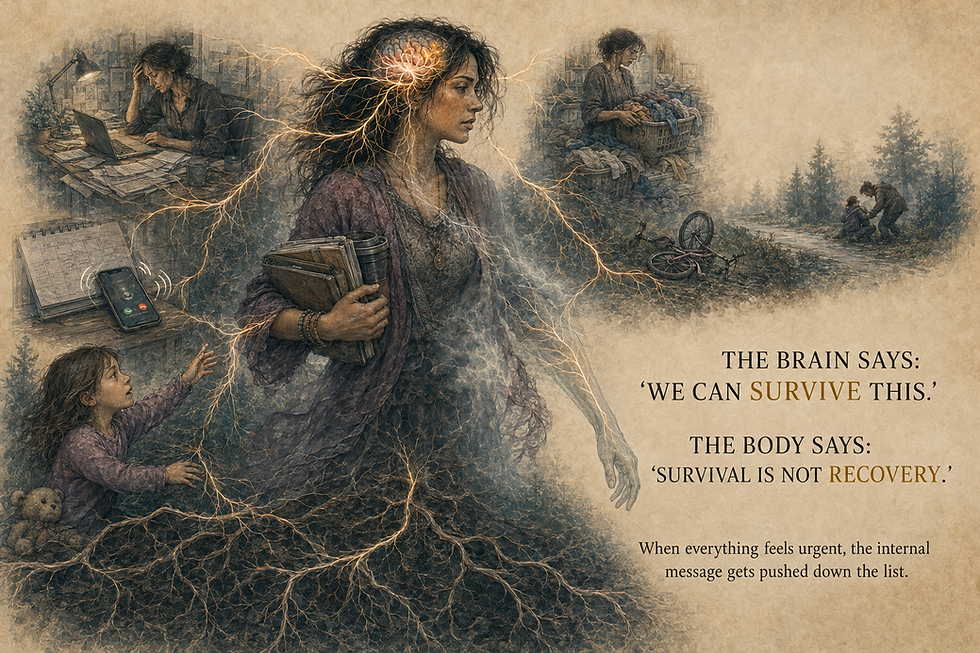
But when the nervous system is overwhelmed, it prioritizes the emergency in front of me.
A grieving family member.
A staffing crisis.
A business deadline.
A child who needs me.
A stranger trapped in a ditch.
The internal message gets pushed down the list.
Dissociation can create even more distance from the body’s warning signals. It allows the brain to say, We can survive this, while the body is trying to say, Survival is not the same thing as recovery.
If my body awareness becomes unreliable, I may:
Recognize symptoms only after significantly exceeding my capacity.
Interpret numbness as improvement because the pain became quieter.
Treat weakness or heaviness as an inconvenience.
Confuse adrenaline and survival-mode energy with genuine physical capacity.
Continue an activity because I can technically tolerate it.
Override tingling, fatigue or loss of coordination until the nerve becomes louder.
Rest only after my body makes continued functioning impossible.
This is how a protective adaptation can interfere with recovery.
Not because my injury is “all in my head.”
Not because calming down can replace medical evaluation or physical rehabilitation.
Not because positive thinking can remove mechanical compression.
It matters because healing depends partly on what I repeatedly do with the injured area—and trauma can make it much harder to notice when I am doing too much.
Pain tolerance is not proof of safety
For most of my life, I treated pain tolerance as evidence of strength.
If I could endure it, I believed I should.
But pain tolerance measures how much sensation I can withstand. It does not measure nerve function, tissue safety or whether an activity is helping me recover.
With nerve symptoms, intensity alone is an especially unreliable guide.
The better questions are:
Is the tingling spreading?
Is sensation changing?
Is my grip becoming weaker?
Am I dropping things?
Does my arm feel heavy, distant or unusually fatigued?
Are symptoms appearing sooner after activity?
Am I recovering between exposures—or merely becoming better at ignoring the consequences?
The goal is not to become frightened of every sensation.
The goal is to become curious early enough to respond.

Even the healer needs healers
This is where Dr. Lisa and Belinda have become essential.
I have spent 15 years developing the hands, instincts and clinical awareness to listen to other people’s bodies.
I can feel guarding.
I can notice compensation.
I can recognize when someone is bracing long before they have words for it.
But expertise does not make me objective about my own body.
Independence does not make me invulnerable.
And being a healer does not mean I can safely treat myself through every injury.
Dr. Lisa does not let my determination become the treatment plan.
She evaluates what my body is actually doing—not what I can force it to accomplish. She helps identify which muscles need to come back online, which structures need protection and which movements my nervous system is not ready to perform safely.
When my instinct is to stretch harder, work around the problem or prove that I can still function, she gives me the brutally honest answer:
Not yet.
Not that way.
Stop.
That is care.
Belinda brings another kind of clinical protection. She understands bodies, patterns and the enormous temptation healers have to keep treating through their own injuries. She can be strong without being harsh and gentle without becoming passive. She helps create a clinic where care continues without requiring me to reinjure myself to prove my value.
Neither of them is teaching me to fear my body.
They are teaching me how to hear it.
They are helping me distinguish a safe challenge from an old pattern of self-abandonment.
They are teaching me that the tiny whisper counts.
That numbness counts.
Weakness counts.
Fatigue counts.
The feeling that something is simply “off” counts.
I do not have to wait for screaming pain to earn protection.
The village that caught me
Here is the difference between this chapter and every chapter that came before it:
This time, I am not alone.
My village—my network—has wrapped itself around the places I can no longer hold by myself.
My dearest friend, Misty, placed her entire family’s schedule into rotation to help care for my children. She is a voice of gentle stillness: kind without becoming passive, loving without disappearing into people-pleasing.
Yo. That is an entirely different level of control.
Kim joined this team intending to be a coach and somehow became the balance to my chaos. She is the calm, strategic mentor who helps bring our roots firmly into the ground so we can finally grow upward without toppling over.
Megan is the angel twin flame to my wanderlust and bendy, adaptable energy. She knows how to roll with change, find the light and locate the silver lining without pretending the storm never happened. She brings joy into the places where it most needs to shine.
There are hardly words sufficient to express my gratitude for Belinda—the friend I did not even know I needed. She carries strength and gentleness at the same time. She can hold a boundary without withdrawing love. She helps make this dream clinically stronger, safer and more sustainable.
There are the friends who adopted my family as an extension of their own and helped build this dream with us.
There is Mike, who noticed a man trapped in a ditch out of the corner of his eye and stopped.
There is my dad, who almost never says no when there is something he can do to help.
He shows up for every single thing I forget in a panic. He comes when the water is leaking, the toilet will not flush, the deck is falling apart or I am one household disaster away from completely losing my sanity.
He does not need a polished plan or a formal invitation. He sees what needs fixing, brings the tools and quietly helps put our physical world back together.
There is my extended family, praying for us every day. They listen when they feel God calling them to cover us a little more closely. Sometimes, before I have even found the words to explain that we are struggling, they feel the Spirit urging them to pray harder—and they do.
And there is my mom.
My mom kept our lights on, our bellies fed and a roof over our heads when even my relentless overworking could not sustain both our household and the business.
She cared for my children.
She gave more than she could comfortably give.
She carried weight that belonged to me because she could see that I was already being crushed beneath it.
There is no polished entrepreneurial sentence that makes that debt of love feel smaller.
I know what she carried.
I know what all of them have carried.
The highs and lows of bringing this business to where it stands today have been extreme.
But for the first time, the dream is not resting entirely on one exhausted nervous system.
It is being held by hands that fix leaking water, arms that hold my children, minds that steady my chaos, hearts that find the light and voices that carry our names to God when we are too tired to pray for ourselves.
Independence was never the final destination
Trauma taught me that independence was safety.
If I did not need anyone, no one could disappoint me.
If I stayed useful, I would remain valuable.
If I anticipated every problem, I could prevent chaos.
If I carried everything myself, I would never have to feel the vulnerability of asking another person to carry me.
But independence taken to its extreme becomes isolation wearing a superhero cape.
It looks powerful from the outside.
Inside, it is exhausted.
Real healing requires something different.
Interdependence.
Not helplessness.
Not surrendering responsibility for my life.
Not expecting other people to rescue me.
Interdependence means allowing capable, loving people to stand beside me and carry the parts that were never meant for one human nervous system.
It means trusting Lisa to protect my rehabilitation.
Trusting Belinda with clinical care.
Trusting Kim with strategy.
Trusting Megan with light and connection.
Trusting Misty with my children.
Trusting my parents with the places where life is leaking, breaking or becoming financially impossible.
Trusting Mike to look toward the ditch.
Trusting my family to pray when I cannot find the words.
Even the healer needs healers.
Even the most independent human needs a village.
Even the most overperforming person must eventually learn to become interdependent if she wants to feel whole.
The value required to stop
The only way to honor this injury is to believe that I possess enough value to protect.
I have to respect my body.
I have to cherish it—not merely appreciate it when it produces enough work to pay the bills.
I have to understand that my purpose is not measured by how much pain I can tolerate.
The light I bring into the world does not become brighter because I burn myself alive to produce it.
My hands have helped thousands of bodies feel safer.
My mind created a clinic, a community and a vision capable of growing far beyond what my hands could accomplish alone.
My presence makes ordinary days better for people I love.
That is worth protecting.
I do not have to destroy the instrument to prove the importance of the music.
My body was never failing to communicate.
It whispered through exhaustion.
It whispered through tingling.
It whispered through weakness, numbness and the increasingly desperate need to stop.
I kept working.
Now, held by the village I spent years helping to build, I am finally learning to listen.
With love,
gratitude and significantly fewer hats,
Kjersten Starr
Founder, Symmetry & Balance Wellness Hub

A note about the science
This essay describes my lived experience and the scientific concepts helping me understand it. Trauma and stress can influence attention, body awareness and pain processing, but they are not being presented as the sole cause of my thoracic outlet syndrome. New or progressive weakness, spreading numbness, loss of coordination, significant swelling, color or temperature changes, chest symptoms or worsening neurological symptoms require appropriate medical evaluation.
Research and educational references: Rauch, van der Kolk and colleagues’ PET trauma-imagery study; pain perception, anxiety and dissociation in PTSD; stress-induced modulation of pain; systematic review of trauma and orientation to bodily signals; pain and interoception systematic review; and international consensus recommendations for neurogenic thoracic outlet syndrome.


Comments