


WHAT THE HECK IS NEUROGENIC THORACIC OUTLET SYNDROME?


Neurogenic thoracic outlet syndrome—mercifully shortened to nTOS—is the reason I am stepping away from hands-on care for eight weeks. It is also the latest reminder that professional knowledge does not make anyone exempt from being a human with a body. Annoying, but true.
The short version: my arm is not lazy, dramatic, or insufficiently motivated. The network of nerves traveling from my neck into my shoulder, arm, and hand is being irritated in a very crowded anatomical hallway. Every time I tried to return to bodywork before that system had settled, my symptoms flared again. Apparently, repeatedly asking an angry nerve, “But what if I do just one client?” is not a scientifically valid recovery plan.
First: the medical term is nTOS. The family term is “neck constipation.”
At dinner, I said my neck and shoulders hurt so badly that I needed to go home and stop holding my head upright. Mike announced that we needed to go home so I could game with him. Before I could explain why that was an objectively terrible plan, RJ delivered the most accurate assessment of my condition I have ever received:
“That is not going to help. That is going to make your neck more constipated.” Neck constipation is not currently recognized by the medical billing system. Spiritually, however, it is flawless. |

The most accurate unofficial medical assessment I have ever received.
So what actually is nTOS?
The thoracic outlet is a small region between the neck and shoulder where important structures travel from the chest toward the arm. The brachial plexus—the network of nerves that carries movement and sensation between the spinal cord and the shoulder, arm, and hand—passes through this neighborhood.
Picture a tiny hallway with several choke points: between the scalene muscles in the neck, between the first rib and collarbone, and beneath the pectoralis minor near the front of the shoulder. If the brachial plexus is repeatedly irritated, stretched, crowded, or compressed somewhere along that route, the result can be neurogenic thoracic outlet syndrome.
That is the “neurogenic” part: nerves. There are also venous and arterial forms of thoracic outlet syndrome, involving blood vessels rather than primarily the brachial plexus. Those vascular versions can create swelling, color changes, coldness, clotting, or circulation problems and need a different level of attention. We will come back to that because some symptoms are not a “book a massage and see how it goes” situation.
Also important: a tingly hand is not automatically nTOS. Neck conditions, shoulder problems, carpal tunnel syndrome, cubital tunnel syndrome, other nerve entrapments, and several medical conditions can mimic parts of this picture. nTOS is a clinical diagnosis made from the story, examination, and appropriate testing—not from one spicy infographic on the internet, including mine.

Concept art—not an anatomy plate. Pain is influenced by many signals; nTOS still requires a real assessment of whether the brachial plexus is involved.
How does that tiny hallway become a nerve traffic jam?
Usually, it is not one cartoon villain. It is a combination of anatomy, load, repetition, injury history, and positions that keep asking the same tissues to tolerate more than they currently can.
Anatomy can set the stage. Some people have an extra cervical rib, an unusual first rib or collarbone, fibrous bands, or muscle variations that make the available space smaller.
Injury can change the neighborhood. A neck, chest, shoulder, or collarbone injury can create swelling, protective muscle activity, or scar-related changes that affect the outlet.
Repetition adds up. Overhead sports, lifting, reaching, manual work, sustained gripping, long computer sessions, and other repeated arm activity can keep loading the same corridor.
Position changes the available space. Symptoms may worsen when the arm is overhead, outstretched, dangling for a long time, or held in a sustained forward position. This does not mean posture is a moral failing. It means position plus time plus load can matter.
Sometimes the answer is “several of the above.” Human bodies love a committee.
One hunchy phone session does not manufacture nTOS. A heavy shoulder bag does not diagnose it. A weird pillow is not a confession. But when a vulnerable system is exposed to the same aggravating load again and again without enough recovery, the whispers can get louder.
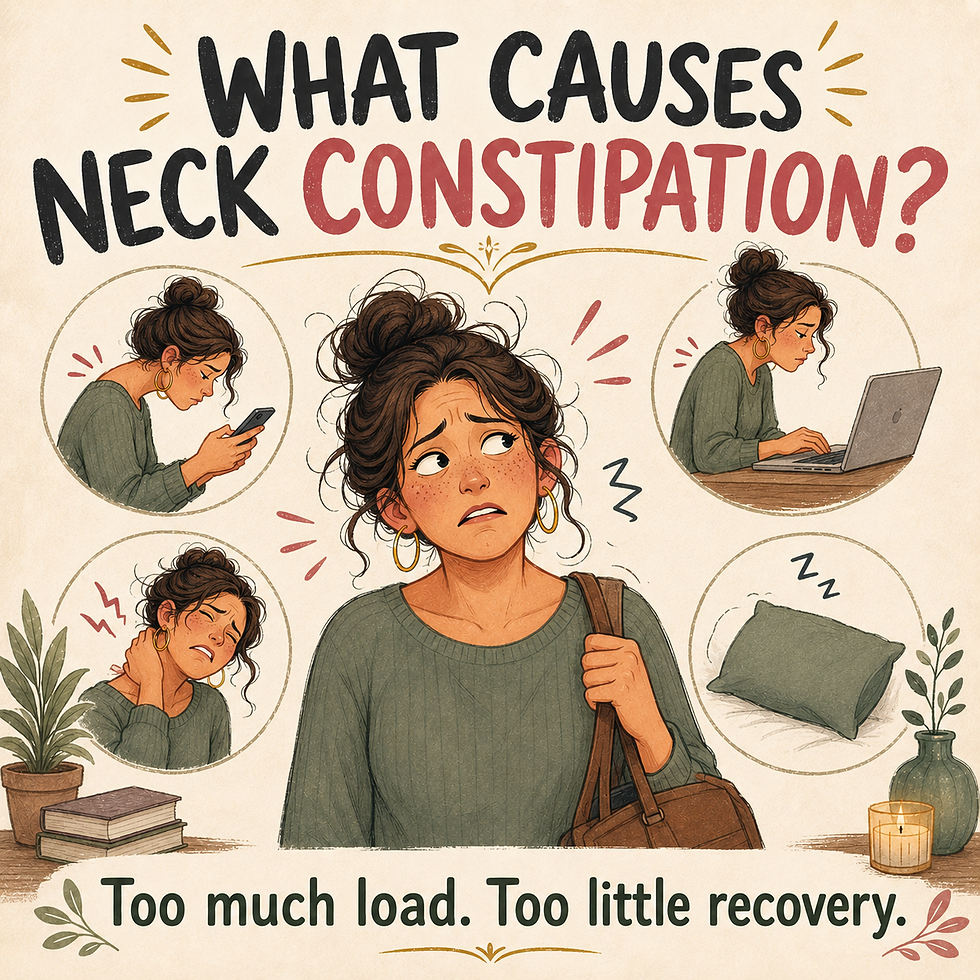
Common load patterns that may aggravate a cranky neck-and-shoulder system—not a diagnostic checklist and not proof of nTOS.
The early warning signs: before your arm files paperwork with HR
Early nTOS symptoms can be intermittent and oddly specific. They may disappear when you change position, rest, or stop the activity, which makes them very easy to explain away. One symptom once does not equal nTOS. A recurring pattern is what deserves attention.
Tingling, buzzing, burning, or numbness in the arm, hand, or fingers. Ring- and little-finger symptoms are common, but the pattern can be broader and may not behave like one tidy nerve map.
An arm that tires suspiciously fast—especially during overhead work, repetitive use, driving, carrying, gripping, or sustained computer work.
Heaviness or a “dead arm” feeling even when the arm looks normal from the outside.
Pain or pressure in the neck, trapezius, upper chest, shoulder, upper back, arm, or hand.
Symptoms that change with position—especially when the arm is raised, outstretched, held forward, or left dangling for a long time.
A less trustworthy hand: weaker grip, dropping things, struggling with buttons or fine motor tasks, or feeling like the fingers have stopped reading the group chat.
Night symptoms that wake you or depend on how the neck, shoulder, or arm is positioned.
Symptoms that keep returning after the activity is over or that take longer and longer to settle.
The useful question is not “Did my hand tingle once?” It is: “Does this keep happening, is it linked to certain positions or activities, and is the pattern becoming easier to trigger or harder to settle?” |
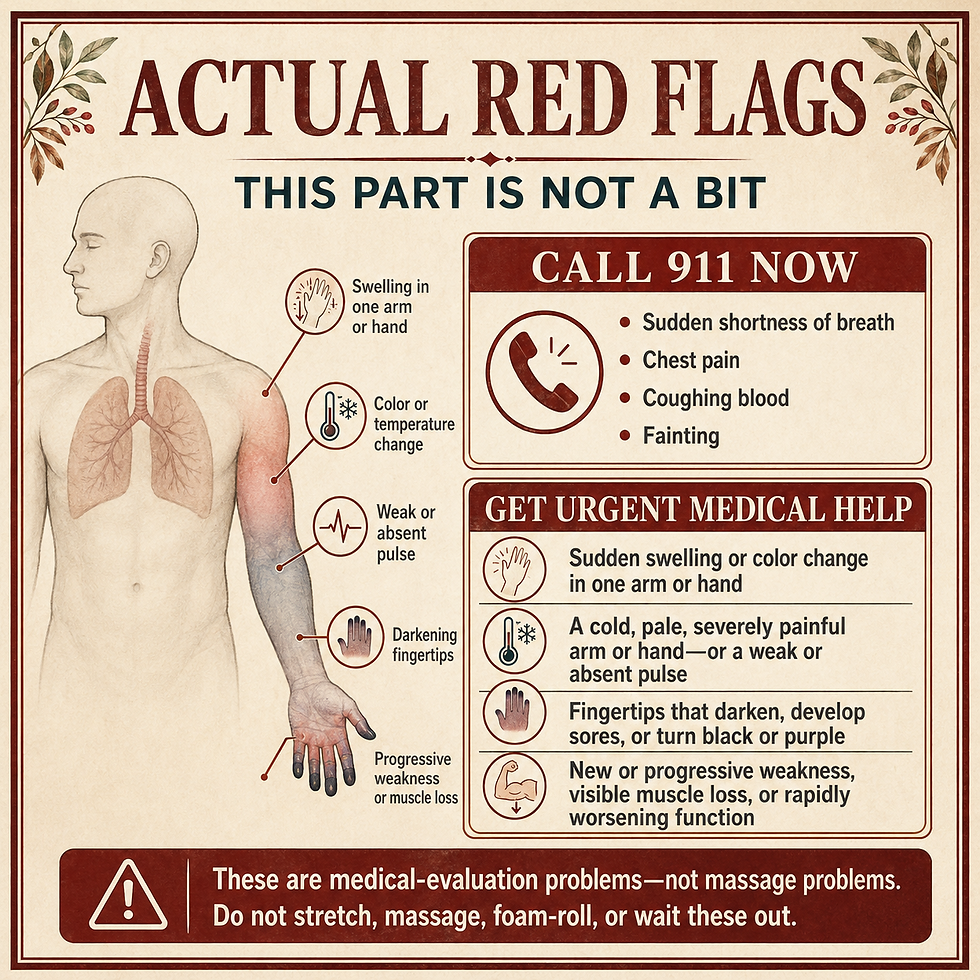
Actual red flags: this part is not a bit
Because the thoracic outlet also carries major blood vessels, some symptoms can point to venous or arterial compression rather than—or in addition to—nTOS. Do not try to stretch, massage, foam-roll, or positively-think your way through the following:
GET URGENT MEDICAL HELP Seek urgent or emergency medical evaluation for sudden circulation-related changes, including: Sudden swelling of one arm or hand, especially with blue, gray, purple, red, or unusually pale color. A hand or arm that suddenly becomes cold, severely painful, weak, or has a weak or absent pulse. Painful fingertips that darken, develop sores, or look black or purple. Sudden shortness of breath, chest pain, coughing blood, faintness, or other possible signs of a clot traveling to the lungs—call 911. New or progressive weakness, visible loss of hand or arm muscle, or rapidly worsening function also deserves prompt medical evaluation. |
Sudden swelling or color change is not a massage problem. A cold, pale hand with a weak pulse is not a “let us see if the knot releases” problem. Those are medical-evaluation problems. Full stop.
Why nTOS can be maddeningly hard to diagnose
nTOS overlaps with several neck, shoulder, and peripheral nerve conditions. There is no single universally decisive test that answers every case, and people can have more than one condition at the same time. Current expert recommendations place heavy emphasis on the history and physical examination, while imaging, X-rays, electrodiagnostic studies, ultrasound, or diagnostic injections may be used to support the workup or rule out other causes.
This is also why I do not recommend repeatedly performing provocative tests on yourself because a reel told you to. Some maneuvers can produce symptoms in people without nTOS, and some people with nTOS will not perform them in a perfectly textbook way. Your body is not a BuzzFeed quiz.
What to do when the whispers start
The goal is not panic. The goal is to notice the pattern before your nervous system has to upgrade from whispering to using a megaphone.
Track the pattern. Note which arm, which fingers, what activity or position triggered it, how long it lasted, and what made it settle.
Reduce the provoking dose. If a task reliably causes tingling, heaviness, weakness, or pain, stop treating that reaction like a character-building exercise.
Change positions before symptoms arrive. Support the arm, vary the task, bring screens and tools closer, and stop making one small area hold the same posture for hours.
Get evaluated if it is recurring, worsening, or affecting strength or function. nTOS is commonly treated conservatively first, often with individualized physical therapy, but the correct plan depends on what is actually happening.
Do not aggressively stretch an irritated nerve into submission. “More sensation” is not automatically “more therapeutic.” Your clinician or physical therapist should help decide what your specific system needs.

A general reminder—not a one-size-fits-all nTOS treatment protocol. Move, support, and rest should be tailored to the person and the actual diagnosis.
My specific plot twist: I kept trying to work through it
I have spent years helping people hear what their bodies are saying. Mine started with symptoms I could still negotiate with, so I negotiated. I rested a little, felt a little better, tried bodywork again, flared again, and remained genuinely surprised by this completely consistent result.
Historically, my body has bounced back quickly. I kept assuming tomorrow would be the day everything settled. But this time, continuing hands-on work is not allowing the system to heal. Every test run keeps aggravating the same symptoms and restarting the argument.
So I am doing the deeply inconvenient, medically responsible, personally challenging thing: I am stepping away from hands-on care for eight weeks, and then reassessing from what my body is actually doing—not from what I wish it were doing.

The part I hope you take with you
Please do not wait for your body to become undeniable before you decide it is worth listening to. Tingling is information. Heaviness is information. Weakness is information. A symptom that reliably appears with a position or task is information. None of those automatically means nTOS—but they do mean your body has entered the conversation.
You do not earn a prize for making the whisper become a scream. I checked.
My neck did not need more motivation. It needed less aggravation, more support, and enough uninterrupted time for the plan to have a chance. I am finally giving it that.
The official conclusion Neck constipation: medically unofficial, energetically flawless. Recurrent tingling, numbness, weakness, heaviness, or positional arm pain: worth a real medical conversation. |
Medical note
This article is educational and reflects both my personal experience and current clinical resources. It is not a diagnosis or an individualized treatment plan. Symptoms in the neck, chest, shoulder, arm, or hand can have many causes. Seek evaluation from a qualified medical professional, especially for persistent, worsening, or function-changing symptoms. Use urgent or emergency care for sudden swelling, color or temperature
change, weak pulse, severe hand pain, chest pain, or breathing symptoms.
Sources & nerd receipts


Comments