


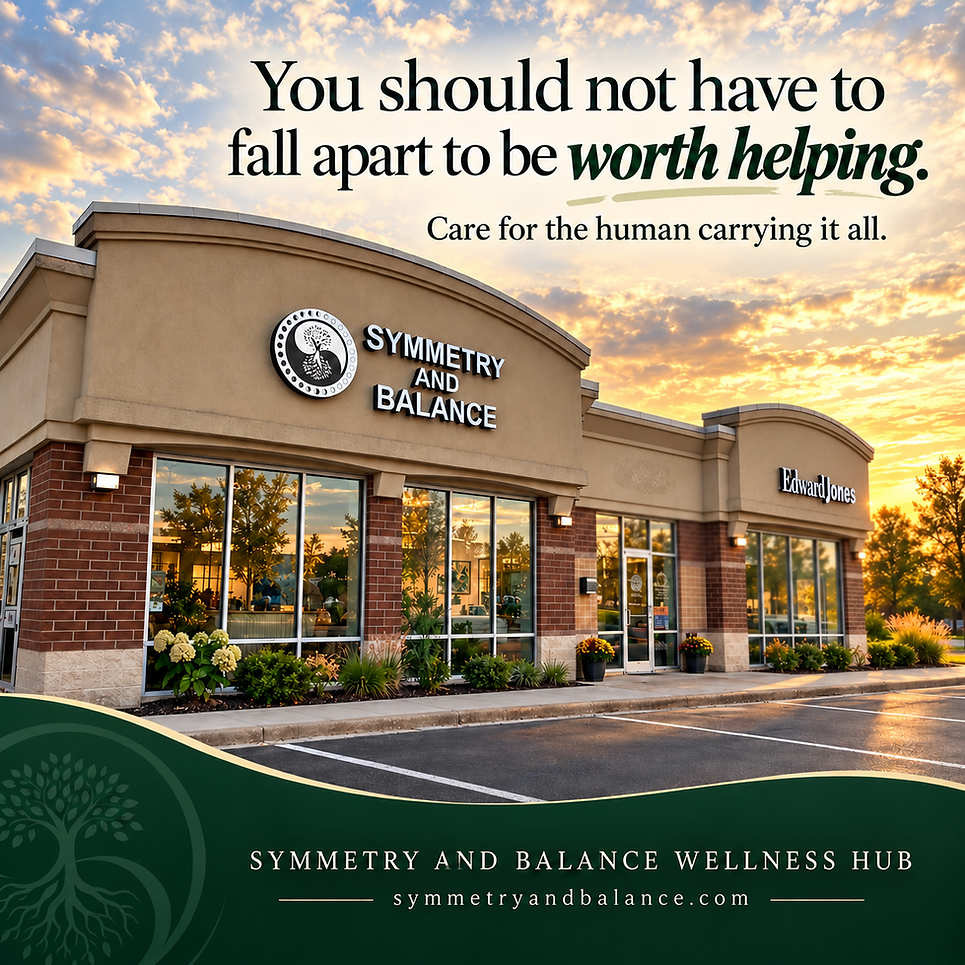
We built this for you.
A place to harbor when life won’t stop storming.
Symmetry & Balance was built on the belief that care should make room for the whole human.
The muscles that hurt. The mind that won’t quiet down. The disability you navigate every day. The grief, the exhaustion, the changing brain, the responsibilities that don’t pause just because you need a minute.
All of you gets to come through our door.
To us, holistic care means paying attention to how those parts of your life fit together—and helping you find ways to live more comfortably in your body through whatever life brings.
Massage and bodywork are part of how we help. So are practical education, movement, coaching, and opportunities to rest. The purpose is bigger than an appointment: we want you to feel heard, understand more about your body, and leave with something useful for the life you’re returning to.
Yes, there are nerd receipts.
Pain is a personal experience shaped by biological, psychological, and social factors. That is part of the International Association for the Study of Pain’s definition—not something we made up because “whole human” sounds nice. Your tissues matter. Your experiences and circumstances matter, too. None of that makes your pain imaginary. It means you deserve care that takes your experience seriously. [1]
Stress has physical effects. Breathing, heart rate, and muscle tension can change when your body responds to a challenge. When stress becomes persistent, it can contribute to problems with sleep, headaches, and other aspects of health. [2]
Relaxation also has measurable physical features, including slower breathing and a reduced heart rate.
Practices such as breathing exercises and progressive muscle relaxation can help some people access that response. Responses vary, and a technique that feels calming to one person may feel uncomfortable to another. [3]
That is why we care about more than how hard someone presses on a muscle.
We care about whether you’re comfortable. Whether you understand what we’re doing. Whether you feel able to say “less,” “different,” or “stop.” Whether the plan fits your body, your energy, and your actual life.
These principles guide our approach. They don’t mean every service has the same evidence or that we can promise a particular outcome. We work within our training, explain your options, and help you find other care when that’s what you need.
We can’t stop every storm. But we can offer a place to harbor.
A place where you don’t have to perform “fine.”
Where you can tell us what hurts, what feels overwhelming, and what you need us to do differently. Where we can help carry some of the weight for a little while as you rest and explore what feeling more comfortable—and safer—in your body might look like.
You don’t have to arrive relaxed. You don’t have to know the right words. You don’t have to apologize for needing a different position, a quieter room, a slower pace, or a moment.
We know that need because we live it, too.
Five whole humans. An unusual amount of life.
This year, one of us is fighting cancer. One makes a three-hour drive each way to care for their father while continuing to be part of this mission. One works full time while taking 18 college credits. One keeps the rest of us in the pen—organizing, communicating, and making sure the important things don’t fall through the cracks.
And then there’s me. Navigating grief, injury, parenting, and the work of keeping this dream alive. Still hoping to build a life with enough room to slow down, too.
We’re people like you. We have bodies that hurt, families who need us, limits we’re learning to respect, and days when asking for help is the hardest thing we do.
That is part of why this place matters so much to us.
How we got here
I’m Kjersten, the founder of Symmetry & Balance.
This clinic was reborn out of desperation, and Cottage Grove rallied around it. You trusted me with your bodies, your pain, and your stories. I became so busy helping people as a bodyworker that the tattoo practice I had planned never even launched.
I loved the work. I still do.
But providing for my family meant working 9–7, six days a week. I did it. I told myself I could sustain it because I needed to.
Eventually, I couldn’t.
Someone saw the vision and believed I could find others who cared the way I did. Together, we could help more people—and build something that didn’t depend on me physically working myself into the ground.
I wanted time with my girls. Room to breathe. A way to keep doing the work I love.
So I took the leap. And I flopped hard in ways I hadn’t anticipated.
Once upon a time, I was the gifted kid who wanted to go to medical school and work in neuroscience. Then PTSD changed the brain game for me.
College became harder. Braining became harder. Peopling was the hardest.
Bodywork gave me a way to use the parts of me that notice, listen, connect, and solve problems. Running a growing clinic required skills and systems I was still learning.
Our team grew before the client volume could support it. People left just as bookings increased. Then we didn’t have enough people to meet the demand. I made mistakes. I underestimated what growing a clinic would ask of me beyond being a good bodyworker.
Belinda and I kept it alive through a lot of last year. I had pneumonia with pleural effusion; they covered. Their dad got sick; I covered. We kept showing up.
Then we found Kim and Megan.
The part I hadn’t been saying out loud
In March, I knew the front-desk helper who had been an angel to me wasn’t going to stay. I knew I couldn’t expect Belinda to carry this with me forever. Kim and Megan were brand new.
The debt that started this company felt crushing. So did the possibility of asking my mom for help with bills again. I was terrified that a risk I had taken could cost my family its stability.
It got dark. For the first time in my life, I wasn’t sure I was going to make it through. The thought of not having to keep going briefly felt like relief—and that frightened me.
In the weeks that followed, connections and support helped me find a feeling of safety in my body again. I let myself be honest. Have friends. Ask for help. Let people see what was happening instead of waiting until I could fix everything alone.
The debt didn’t disappear. But I no longer had to carry every feeling about it by myself.
My well-being matters beyond this business, whatever happens next. I’m sharing this because asking for support changed something important for me—and because nobody should have to wait until they’re falling apart to deserve care.
A team made room for me to be human
I have never been tidy, organized, or Type A. Enter Kim: the other part of the brain.
Together, Kim, Megan, and Belinda helped keep the clinic going while my bonus mom was declining, so I could be there through her final breaths.
This year also brought six weeks away from hands-on work because of thoracic outlet problems. I returned after the first loss of a parent I had ever experienced, with an injured hand.
But I had a team.
We’ve covered for each other through illness, grief, school, and family responsibilities. That care for each other is part of what makes this place worth protecting.
Now we’re working toward a business that can support that care reliably.
The work is real. So is the need for stability.
In August 2026, our numbers had improved 250% from our origional opening.
We are pursuing financing while working on consistent bookings, clearer systems, realistic staffing, and the financial structure needed to make this sustainable for our team and for our clients so when someone gets sick there's someone there to cover, when one of us is injured, there is something to fall back on. Someone to help. In turn we are all here to help you.
And trust me when I say we have seen it all, between the 5 of us and the eventual 7. We have held the weight of horrible stories and losses and amazing recovery. No one does this work without a personal reason to want to help. Because of that we can be safe place to rest without having to explain why.
I don’t want to be a millionaire. I want a stable home, a working car, time with my family, and time for the work I love.
I want that same safety for my team.
We want a clinic where someone in pain can find thoughtful, individualized bodywork QUICKLY. Where someone who can afford $30 a month can find useful education, resources, and community. Where practitioners can respect each other’s health, limits, and passions without sacrificing basic needs.
As the business becomes stable, our goal is to put surplus back into accessible resources and free or subsidized care.
I cannot build that alone. Together, I believe we can make a difference—one little ripple of care, safety, stability, and connection at a time.
If you can help, I would deeply appreciate it.
How do you help??
Purchase future care
If care is already in your plans and comfortably within your budget, a gift card helps us today and gives you care to use later. Buy one for yourself or someone you love.
Buy one that covers account credits for the next 4 years. It all helps.
Our commitment is that purchased gift-card balances will not expire and will remain available while Symmetry & Balance is operating, unless you explicitly ask us to relinquish yours. Gift cards retain their purchased dollar value; future services are charged at the prices in effect when you book. These are purchases for future care, not tax-deductible charitable donations.
Make a plan to feel a little less creaky
Our Hallowthanksmas specials give you ways to plan care for the weeks ahead. The skeletons have apparently joined the holiday planning committee, and honestly, they understand the importance of maintenance.
Choose the offer that fits your needs, schedule, and budget. Each package has its own inclusions and terms.
Fall in love with the Portal and the 15% discount and share it with everyone.
Share our website. Tell a friend about your experience. Leave an honest review. Sometimes the most helpful thing is letting someone know there’s a place nearby where they can ask for support. Share a testimonial on Facebook and tag us. Say a prayer. IT all helps.
Come see us
You don’t have to commit to a package to start. Explore our services, book a visit, or ask Kim to help you find a starting point.
Final Note: Please don’t trade your stability for ours.
If helping us would make your own life harder, please keep that money for your groceries, your bills, your health, and your family.
Passing our hardship to you would go against everything we’re trying to build.
We want you cared for. We want you at your best. And on the days when your best is simply getting through, you still matter just as much.
You belong here whether you purchase anything or not.
I never want to stop being here to help. I just want to be able to breathe—and build a place where my team and our community can breathe, too.
We built this for you. Come find your breathing room.
With gratitude, a little chaos, and a very stubborn dream,
Kjersten & the Symmetry & Balance team
The nerd receipts
[1] Pain involves the whole person.
International Association for the Study of Pain: IASP Terminology — Pain. Its definition and accompanying notes recognize biological, psychological, and social influences, and emphasize respecting a person’s report of pain.
https://www.iasp-pain.org/resources/terminology/
[2] Stress has physical effects.
National Institutes of Health, National Center for Complementary and Integrative Health: Stress. An overview of the stress response, the effects of long-term stress, and approaches to managing it.
https://www.nccih.nih.gov/health/stress
[3] Relaxation is a physiological response, with individual differences.
National Institutes of Health, National Center for Complementary and Integrative Health: Relaxation Techniques: What You Need To Know. Explains relaxation practices, the evidence, limitations, and possible unwanted experiences.
https://www.nccih.nih.gov/health/relaxation-techniques-what-you-need-to-know
These sources inform our approach to care. They do not establish that every service we offer treats every condition or produces the same results. Our services complement appropriate medical and mental health care.


